
Knowledge Hub
Layer by Layer: The History of Hobby 3D Printing – Part 9
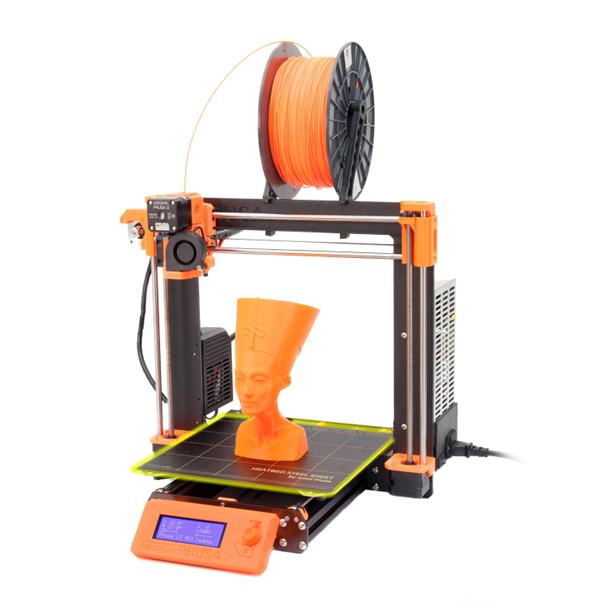
We’re continuing our series revisiting the most influential FDM 3D printers of the past two decades, tracing how the technology leapt from early, hands-on rigs to today’s near plug-and-play machines. This time a true milestone takes center stage: the Prusa i3 MK3, a printer that elevated reliability, user experience, and open-source innovation to a new level.
Original Prusa i3 MK3 (2017)
A printer that doesn’t just work—it keeps working.
Launched at the end of 2017, the Original Prusa i3 MK3 was a revolutionary upgrade to the i3 platform. It brought features once reserved for pricey industrial machines, sensors, self-checks, power-loss recovery, automatic calibration, quiet operation, while staying proudly open source.
Build and motion system
The frame paired a robust, powder-coated aluminum Y-chassis with reinforced 3D-printed parts. The result was a stable, long-lived structure that clearly pushed the MK3 beyond “DIY” territory.
The motion system kept the proven Prusa i3 layout: the bed travels on Y, the extruder rides X and Z. The headline addition was the SuperPINDA auto-leveling probe, accurately sensing bed height to deliver a consistently perfect first layer, the cornerstone of reliable printing.
The direct-drive, in-house MK3 extruder used a strong stepper, integrated cooling, a filament sensor, and a swappable nozzle. Smooth feeding plus refined cooling produced excellent print quality, even with flexible materials.
Electronics and materials
Under the hood, the MK3 ran Prusa’s 8-bit EINSY Rambo control board. TMC2130 drivers enabled sensorized control, ultra-quiet motion, and stall detection. It supported a wide range of 1.75 mm filaments, PLA, PETG, ABS, ASA, flex, and even composites.
The standard nozzle was 0.4 mm (user-swappable from 0.25 to 0.8 mm). The magnetic, PEI-coated heated bed made for easy cleaning, easy plate swaps, and excellent adhesion. Build volume was about 250 × 210 × 210 mm; typical speeds 60–100 mm/s, tunable up to 200 mm/s. Layer heights from 0.05–0.35 mm covered everything from detail parts to fast prototypes.
Comfort and safety features
- Power Panic: resumes a print after a power outage.
- Filament Sensor: detects runout or jams automatically.
- Mesh Bed Leveling: compensates sub-millimeter bed variances.
- Stealth mode: genuinely quiet—the kind of quiet you can sleep next to.
Beyond hardware, the MK3 was a philosophical milestone: proof that an open-source community and serious engineering can produce results on par with industry.
Why it became the benchmark
The MK3 was the first open-source hobby printer that didn’t demand modding, soldering, or endless recalibration. It’s manufactured near Prague, Czech Republic, by a transparent, community-centric company. Premium behavior with community documentation and parts support made the MK3 not only a workhorse, but also a superb learning platform.
Legacy
The MK3 line topped “best hobby 3D printer” lists for years. It was followed by the MK3S, then the refined MK3S+, before the MK4 took the baton in 2023. Even so, the MK3 remains in classrooms, shops, and homes, and in 2025 it’s still an industry touchstone.
Have you seen one in action? Which printer would you call the most iconic of the past 20 years?