
Knowledge Hub
Why do we dry filaments?
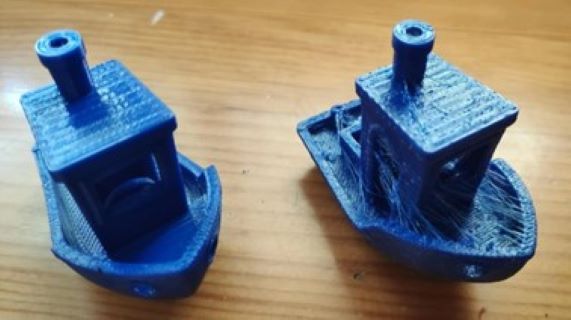
You’ve probably already come across it while browsing the internet: most filaments are recommended to be dried before use, as over time they can absorb a significant amount of moisture. You may also have noticed that material left in a humid environment for too long becomes more brittle, and objects printed with damp filament show weaker properties compared to those made from properly dried material. But what exactly is the reason behind this?
Filaments are made of plastics, which are usually composed of some type of polymer and the necessary additives.
Polymers consist of molecular chains built up from tens or even hundreds of thousands of repeating units. These chains can be roughly imagined as a bowl of spaghetti: they lie tangled on top of each other, partly entangled.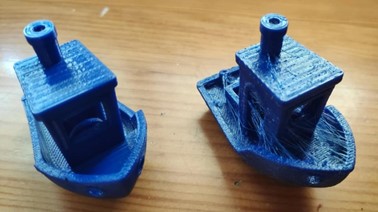
Figure 1. Wet filament often produces “stringing” [1]
From the perspective of moisture absorption, we can distinguish two types of polymers:
- Hydrophobic materials, which do not require drying as they do not bind water. Typical examples are polyolefins such as polypropylene (PP) or polyethylene (PE).
- Hydrophilic materials, which are capable of absorbing water and therefore need drying. These include polylactic acid (PLA), polyethylene terephthalate glycol (PET-G), and polyamide (nylon, PA).
The water absorption of hydrophilic materials is due to the hydrophilic groups in their molecular chains (such as –OH, –COOH), which can bind water molecules via intermolecular – that is, between molecules – bonds. The higher the relative humidity of the environment, the more moisture these materials will absorb.
Moisture content affects polymers in a way similar to temperature: since the presence of water causes the molecules to move further apart, the modulus decreases and ductility increases. This effect is significant for certain materials; for example, the tensile strength of some polyamides in the wet state can be up to 20% lower than in the dry state [2].
It is during processing that water causes the greatest problems: at printing temperatures, water turns into vapor and escapes from the nozzle along with the filament. As a result, the printed object’s surface may become bubbly and significant stringing may occur. On the molecular level, the situation is no better: boiling water can chemically break the molecular chains (for example in PLA, PA), leading to many shorter chains instead of long ones, which means much weaker mechanical properties. This chemical reaction is called polymer hydrolysis, and it is considered extremely harmful [3]. Hydrolysis typically becomes an issue at processing temperatures.
We can also observe hydrolysis in nature: for example, our body breaks down maltose into glucose using water – this reaction is also hydrolysis.
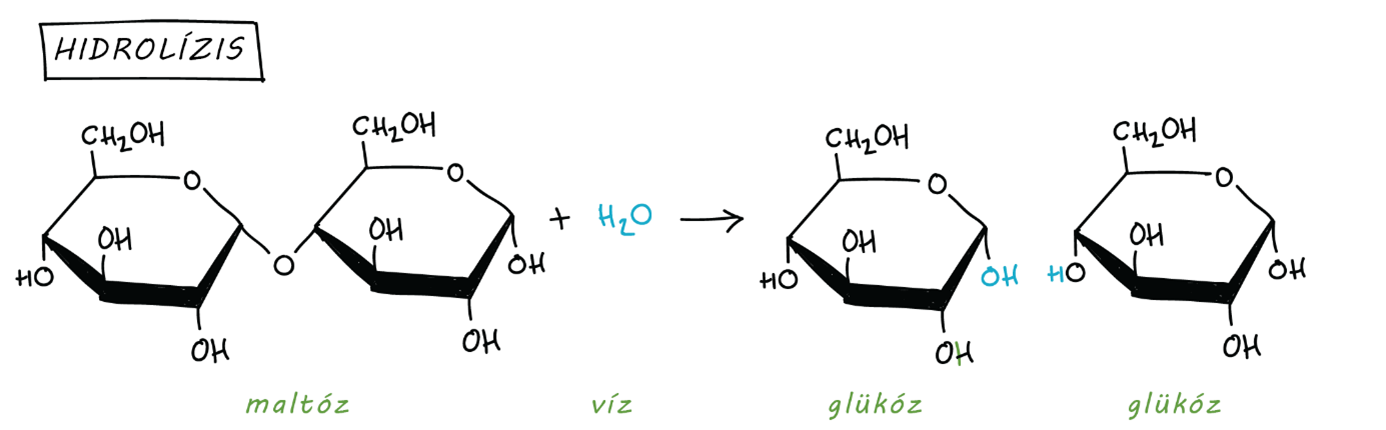
Figure 2. Hydrolysis in nature [4]
In addition to hydrolysis, other environmental factors can also cause polymer chain degradation, such as prolonged heat exposure and UV radiation, which we will discuss in more detail in the future.
What does this mean during printing?
There are several signs that a filament is wet during printing:
- The most obvious is stringing – material oozing from the nozzle during travel moves, as shown in Figure 1.
- A popping sound during printing may indicate water boiling out of the filament.
- The printed object may have a duller, bubble-marked surface, which is another clear sign of moisture.
References:
[1] https://www.reddit.com/r/FixMyPrint/comments/ny2m7j/difference_between_dry_and_wet_filament/
[2] Bodor Géza, Vas László M.: Polimer anyagszerkezettan, Budapest: Műegyetemi Kiadó, 2005., pp. 222–227.
[3] Petr Stloukal et al.: The influence of a hydrolysis-inhibiting additive on the degradation and biodegradation of PLA and its nanocomposites, Polymer Testing 41 (2015) 124–132.