
Knowledge Hub
Layer by Layer: The History of Hobby 3D Printing – Part 1
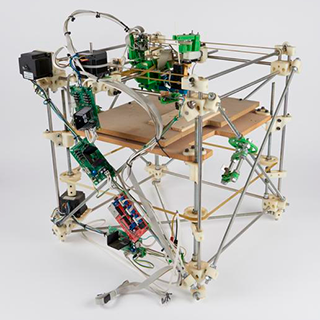
These days it feels perfectly normal to have a 3D printer at home, but it wasn’t always that way. In our new series, we’re rewinding to the early days of hobby/desktop 3D printing and the milestones that shaped it. Part one spotlights the RepRap Darwin (2007), the machine many credit with kick-starting the home 3D-printing revolution.
RepRap Darwin — the forebear of open-source printers
These days it feels almost normal to buy a desktop 3D printer, unbox it, switch it on, and start your first print. Printers are faster, quieter, more precise and increasingly affordable. But how did we get here?
In this new blog series we’re rewinding to the early days and revisiting the iconic machines that laid the foundations of today’s hobby 3D-printing scene. We open with a true legend: the RepRap Darwin, released in 2007 and still a symbol of community-driven 3D printing.
RepRap Darwin (2007) — the printer that printed itself
Darwin was the first serious step toward bringing 3D printing out of industrial labs and into the home. Its defining idea was self-replication: many of its parts could be re-printed on another Darwin. And the project was fully open source, both hardware and software.
Key specs
- Designer: Dr. Adrian Bowyer (University of Bath, UK)
- Year introduced: 2007
- Material: PLA (later ABS), 3 mm filament
- Build volume: ~200 × 200 × 150 mm
- Printing speed: ~15–20 mm/s
Not plug-and-play: and that was the charm
Darwin was the classic “build it yourself” project. Assembly called for mechanical skills, electronics savvy, and software know-how. There were no canned profiles, no auto-calibration—every working printer was the product of its owner’s sweat and determination. That was the magic. Darwin proved you could build your own machine and, in doing so, sparked a movement.
How it worked: mechanics and electronics
Mechanically, Darwin was simple yet clever. A cube-shaped frame made from threaded rods held everything together. 3D-printed brackets tied the structure into a rigid, easy-to-assemble whole. The toolhead moved in X and Y, while the bed traveled on Z. Linear motion came from threaded rods driven by stepper motors: precise, accessible, and garage-friendly.
Electronics followed the same spirit of tinkering and experimentation. An Arduino-based controller drove NEMA 17 steppers. The hotend was a DIY affair, and the build plate was unheated—so PLA was the most forgiving choice. Early RepRap firmware handled motion and extrusion, laying down the groundwork for the entire open-source 3D-printing ecosystem.
Why was Darwin a milestone?
Darwin was more than a machine; it set the culture and ethos that shaped 3D printing for years. Full openness enabled knowledge-sharing, fueled the open-source movement, and helped democratize digital fabrication. It inspired early models from MakerBot, Prusa, and many others—pretty much the root of today’s DIY printer culture.
Legacy and impact
Of course, Darwin can’t compete with modern printers for speed or print quality. Today’s machines far surpass its components and design choices. But its influence is still everywhere: most consumer FDM printers trace their lineage back to RepRap. Darwin showed you don’t need an industrial lab or a massive budget to create technology—and to build a community around it.
What do you think?
Do you know the story of the RepRap Darwin—or even build one back in the day?Which 3D printer would you call the most iconic of the last 20 years?
Tell us in the comments—we’d love to hear your printing stories.