
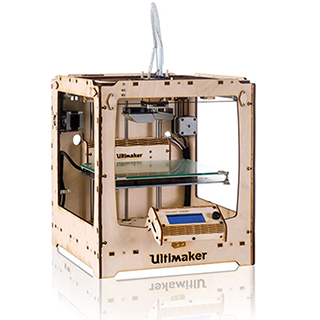
The printer that took hobbyists seriously
The Ultimaker Original hit the market in 2011 from the Dutch team at Ultimaker. It wasn’t just another DIY kit, you could feel it reaching into the professional world with its performance.
For many, this was the moment the community could finally say: FDM wasn’t just an exciting hobby anymore, it could be a bona fide, industry-grade manufacturing technology.
Build and mechanics — fast, precise, dependable
The Ultimaker Original used a laser-cut plywood frame with tight, puzzle-like joints. The boxy, closed form didn’t just look neat, it delivered a rigid, stable foundation for printing, which was a big part of why the machine earned a reputation for reliability.
Its motion system was pioneering for the time: the Ultimaker Original was among the first to use a Bowden extruder layout, mounting the drive motor on the frame rather than the printhead. That kept the toolhead light, allowing quicker, more accurate moves and noticeably better print quality at higher speeds.
Axes rode on linear bearings, with well-designed belt drives transmitting motion. The result was quiet, smooth, precise operation, fast and reliable in one package.
At the heart of the machine was an Arduino Mega–based custom controller called the UltiBoard, handling all motion and process control. The go-to material was 2.85 mm PLA, though the platform was open to other plastics. The build volume, about 210 × 210 × 205 mm, was considered huge at the time and a real advantage over competitors.
Layer heights ranged from 0.06 to 0.3 mm, enabling impressively fine detail, and print speeds could reach up to 150 mm/s, exceptional for that era. Ultimaker’s in-house Aluhotend with a 0.4 mm nozzle ensured stable, even extrusion for consistent quality and reliability.
What made it truly special?
The Ultimaker Original struck a rare balance of performance, reliability, and speed. It wasn’t the cheapest option, but technically it was ahead of the curve, arguably even outpacing the early Prusa i3 in several respects.
Schools, design studios, and development engineers adopted it for prototyping, functional parts, and bespoke prints. It ran steadily, printed quickly, took mods in stride, and did all that while remaining open source.
Legacy
While Ultimaker has since moved on to premium, closed-ecosystem machines (like the S5 and S7), the Original has earned cult status. It symbolizes an era when you still built your own printer by hand, yet the output was edging into industrial territory.
This machine proved that 3D printing wasn’t just a pastime—it was a real technological platform you could build a business on.
Have you crossed paths with an Ultimaker Original?
Have you used one? Built one? Seen one in action?
Share your experiences with us, and tell us which machine you think is the most iconic in 3D-printing history!
We’ll be back soon with another landmark model, follow along so you don’t miss it.