
Our series continues, looking back at the most influential FDM 3D printers of the last ~20 years. We’re tracing how we went from garage-built projects to today’s out-of-the-box, plug-and-play machines. This time we’re spotlighting a printer that became more than a technological milestone, it grew into a movement: the Prusa i3 (2012).
Knowledge Hub
Layer by Layer: The History of Hobby 3D Printing – Part 4
The movement that became a machine
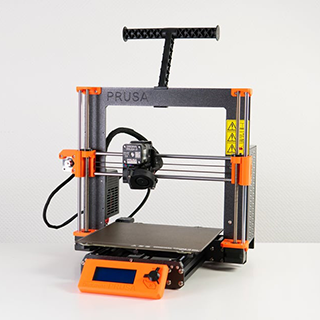
In 2012, Josef Prusa, already one of the best-known, most active voices in the RepRap project, introduced the Prusa i3 (Iteration 3). The printer became an instant crowd-favorite: reliable, easy to build, shared freely with open plans, and affordable. It hit the sweet spot for a rapidly growing demand in community and at-home fabrication.
It was both simple and thoughtfully engineered, fully usable out of the box yet easy to upgrade and mod. Whether you were a beginner or a seasoned maker, the i3 met you where you were.
Rigid frame, clean motion system
From the outset, structural stability and ease of assembly were core goals. The frame typically used laser-cut metal plates or robust printed parts, with twin Z uprights to keep prints square and true. The three axes were cleanly decoupled, which boosted accuracy.
The bed traveled on Y, while X and Z carried the extruder. Linear bearings on smooth rods and NEMA 17 steppers delivered quiet, steady motion, a big step up from the noisy, imprecise machines common at the time.
Electronics, extruder, and performance
Classic i3 builds ran the Arduino Mega + RAMPS 1.4 combo, easy to program, expand, and maintain. Later, Prusa introduced custom electronics that were even more reliable and feature-rich.
Extruders and hotends varied, MK8, Wade’s, and other DIY setups were common. Most users ran a 0.4 mm nozzle at 190–240 °C. Materials included PLA, ABS, PETG, and other mainstream filaments, enabling a wide range of applications.
Core parameters
- Build volume: ~200 × 200 × 180 mm
- Layer height: 0.10–0.30 mm
- Speed: 40–60 mm/s stock; 80–100 mm/s with tuning
The triumph of open source
The i3’s true power wasn’t just the hardware, it was the philosophy behind it. Fully open source, with designs, software, and firmware free to use and modify, it sparked an explosion of community innovation. Within a short time, hundreds of clones and derivatives appeared worldwide. Brands like Anet (A8), Geeetech, and even Creality built on the i3’s foundations, Creality later moved toward more closed ecosystems, but the lineage is unmistakable.
Expandability and community-driven upgrades
Thanks to its modular design, the i3 was endlessly moddable. Popular upgrades included a heated bed to cut warping and boost adhesion, especially on larger parts, along with automatic bed leveling to streamline setup and prevent first-layer issues. Filament presence/runout sensors could pause a job before the spool ran dry, and dual-extruder options enabled two-color prints or mixed-material parts with added functionality.
A legacy that still shapes the present
The Prusa i3 became one of the world’s most recognized and widely used 3D printers. Schools, makerspaces, startups, and hobbyists adopted the platform, and its impact on the spread of desktop 3D printing is hard to overstate.
Today, Josef Prusa’s lineup includes industrial-leaning machines, like the Prusa CORE One, Prusa MK4, and Prusa XL, but you can still feel the community spirit that took shape with the i3.
Did you own an i3?
Have you used one, seen a clone, or are you still printing on one today?
Share your experiences, and stay tuned for the next installment featuring another legend from 3D-printing history.
If you’d like, I can also draft a short cover blurb or social-ready highlights for sharing.