
Knowledge Hub
Layer by Layer: The History of Hobby 3D Printing – Part 8
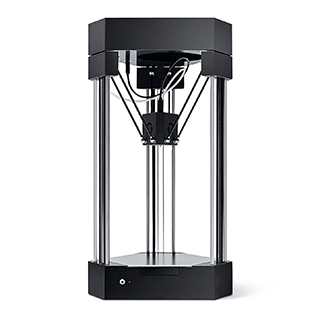
We’re continuing our series revisiting the most influential FDM 3D printers of the past two decades—so we can see, together, how the tech evolved from early tinkering to today’s almost fully automatic plug-and-play machines. This time, the spotlight is on a truly special printer—one that was as much a piece of art as a production tool. Meet the FLUX Delta.
FLUX Delta (2016)
The printer that was as much artwork as tool
After a successful Kickstarter, the Taiwan-based FLUX team introduced the FLUX Delta, a machine that combined a classic delta layout with a clean, enclosed design and a multifunction toolhead. With the right add-ons it could handle engraving, 3D scanning, and later even pen plotting, all on the same base platform.
Design and operation
For its time, the FLUX Delta was genuinely distinctive, both in looks and in engineering. Its delta kinematics used three vertical arms to guide a magnetically attached toolhead, a setup that felt modern while delivering precise, graceful motion.
The chassis was compact and enclosed in a cylindrical form that lent the printer a futuristic presence. At just 30 cm tall, it fit comfortably on a desk. The build area measured about Ø170 × 200 mm, which was ample for smaller models and prototypes.
A Bowden extrusion system paired with a quick-swap head made it easy to switch functions: print in 3D, then pop on the engraver or the scanner. The Delta was optimized for 1.75 mm PLA and lacked a heated bed, so material choices were more limited, but the overall simplicity and reliability kept it popular.
Typical print speeds ranged from 60–100 mm/s, strong for its class. Connectivity was thoroughly modern: control via USB or Wi-Fi, plus a companion mobile app. The signature multihead approach used a single magnetic latch for rapid changes, while FLUX’s own FLUX Studio software offered a polished, easy interface, trading a bit of the freedom of open-source slicers for user-friendliness.
On the device itself, touch buttons and LED indicators handled interaction. There was no LCD, yet the Delta still managed to blend minimalist design with up-to-date functionality.
Why it stood out
This wasn’t a tinkerer’s playground so much as a design-oriented desktop machine. It was made for people who wanted to try 3D printing at home, do a bit of engraving, then swap the hotend back in, without endless calibration. The system was relatively closed and not meant for deep customization, but the multifunctionality was the real draw at a time when multi-tool home machines were rare.
In short
The FLUX Delta was a sleek, multifunction device that married the elegance of delta motion with an almost Apple-like design philosophy.