
Knowledge Hub
What to Print With, and Why? – ABS
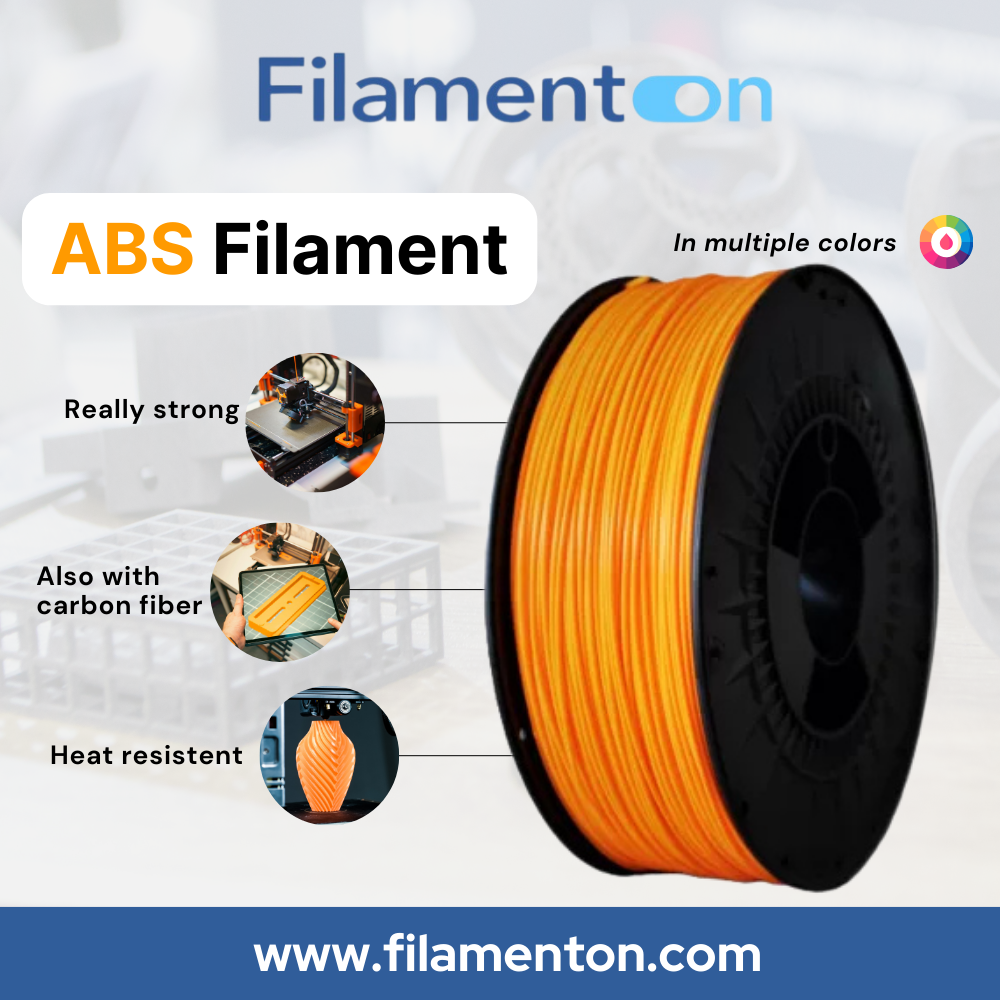
ABS is one of the oldest and most popular engineering materials in 3D printing. It is strong, impact-resistant, and heat-resistant – which is why it has been an industrial standard for decades, used everywhere from LEGO bricks to automotive parts. Printing with ABS requires more attention than PLA or PETG, but in return, you get durable, truly functional prints.
ABS – the classic engineering filament
In the world of 3D printing, ABS (acrylonitrile butadiene styrene) has long been a household name. It is one of the most commonly used plastics in traditional manufacturing – found in car parts, household appliance housings, and LEGO bricks. No wonder it also became one of the first filaments used in 3D printing.
🔬 Scientific background and properties
ABS is composed of three components:
- Acrylonitrile – provides chemical resistance
- Butadiene – adds toughness and impact resistance
- Styrene – ensures processability and strength
This combination makes ABS a strong, impact-resistant, heat-resistant, and easily machinable plastic that often outperforms PLA or PETG – though it requires more care to print successfully.
⏳ ABS in 3D printing
As early as the 2000s, ABS was used in the first FDM/FFF printers because it was widely available and versatile in industrial use. It was also common in the early RepRap days, though it quickly became clear that ABS wasn’t the friendliest material for home environments. Thus, ABS remained the favorite for advanced users and technical projects, while PLA became the go-to for beginners.
🖨️ How to print ABS
Printing ABS has more challenges than PLA or PETG, but in the right environment it’s very manageable:
- Nozzle temperature: 230–260 °C
- Bed temperature: 90–110 °C
- Cooling: minimal or none – too much airflow causes warping
- Environment: closed, draft-free chamber strongly recommended to avoid cracks and warping
Another advantage: ABS can be post-processed easily – sanded, drilled, glued, and polished with acetone vapor for a smooth, glossy finish.
⚖️ Pros and cons
Pros:
- Higher heat resistance (~90–100 °C)
- Strong and impact-resistant – great for mechanical use
- Durable, long-lasting
- Easy to machine and post-process
Cons:
- Prone to warping, requires a more advanced printer
- Noticeable odor during printing
- Harder to print than PLA or PETG
- Sensitive to UV outdoors, can become brittle over time
👤 Who is it for?
ABS is ideal if you want to print:
- Functional, durable parts (mechanical components, repair pieces, prototypes)
- Items exposed to higher temperatures (e.g. car interior elements)
- Smooth, aesthetic surfaces with post-processing
Less suitable for beginners or printers without an enclosure – in such cases, PETG or ASA may be a better alternative.
🎨 Why FilamentOn ABS?
If you need reliable, heat-resistant (~90–100 °C) and impact-resistant prints, ABS is the classic engineering choice. FilamentOn offers three easy-to-navigate categories to match your goals: ECO, SPECIAL, and PREMIUM.
- FilamentOn ECO ABS – stable choice for everyday technical prints
- FilamentOn SPECIAL ABS – combines technical strength with visual options (colors, finishes)
- FilamentOn PREMIUM ABS – consistent quality, wide color palette, excellent value
🧠 Summary
ABS remains one of the most defining engineering filaments, indispensable when you need durable, heat-resistant, and impact-resistant parts. While it requires more care during printing, the results are often worth it: strong, long-lasting prints ready for real-world use.