
Knowledge Hub
What to Print With, and Why? – PETG
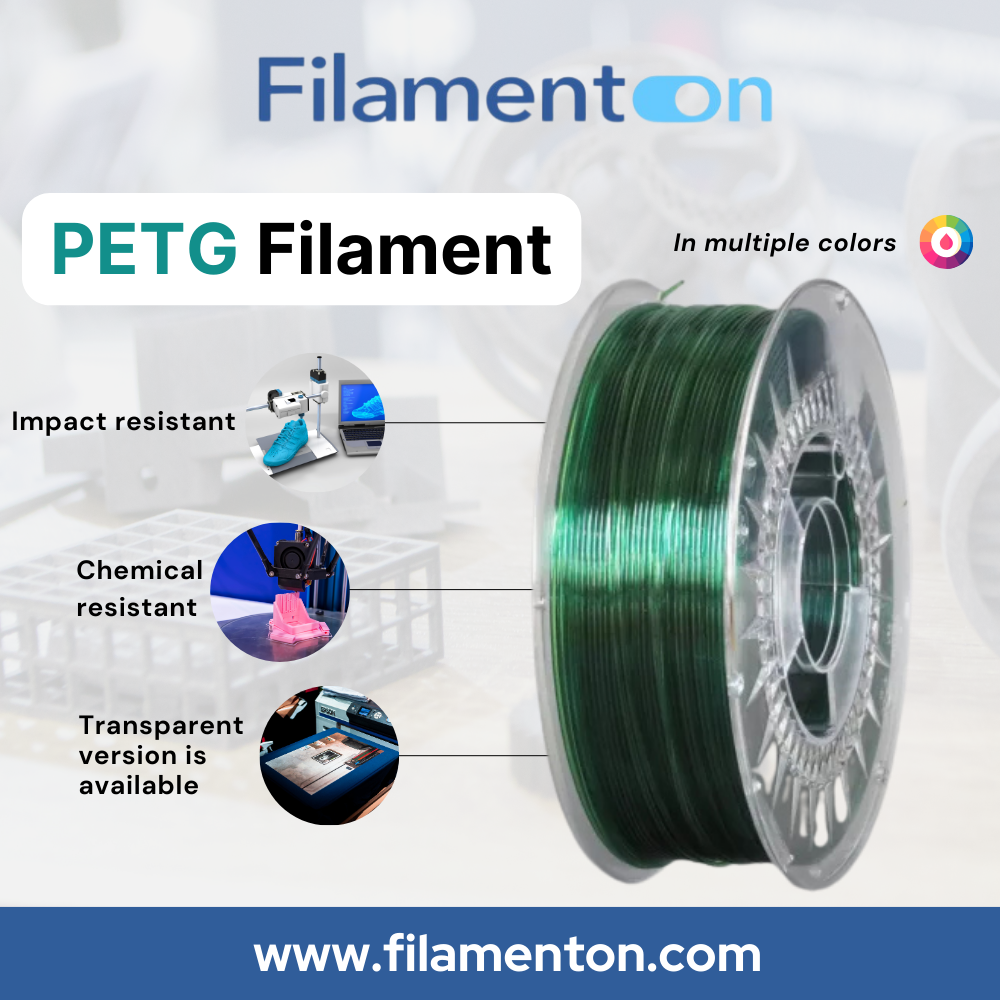
PETG is the true “workhorse” material of 3D printing: stronger and more heat-resistant than PLA, yet much easier to print than ABS. It’s durable, tough, and less prone to warping, making it suitable for everything from hobby prints to functional prototypes. An ideal choice for anyone looking to create reliable, long-lasting parts.
PETG – The Entry Point to Engineering Filaments
If PLA is the friendly starter filament, then PETG is the tough, dependable material that eventually finds its way into every workshop. The name reveals its essence: PET (polyethylene terephthalate) modified with glycol. The glycol additive improves printability and resistance to brittle failure, resulting in a material that’s easier to print than ABS, yet stronger and more heat-resistant than PLA.
🌱 A quick scientific background – what makes PETG “G”?
Classic PET (the same material used in beverage bottles) tends to crystallize. Glycol modification reduces this tendency, making the material easier to process: less brittle, smoother extrusion, and less whitening when bent. The result? Excellent impact resistance, decent heat tolerance, and user-friendly printability.
⏳ How did PETG enter 3D printing?
As an industrial material, PET has been around for decades, but in 3D printing PETG only gained traction in the mid-2010s. The community was searching for something “stronger than PLA, but easier than ABS.” PETG fit perfectly: minimal warping, strong layer adhesion, smooth surfaces – all without the need for a heated chamber.
Printing with PETG – Tips & Characteristics
PETG’s biggest personality trait is stickiness: it bonds strongly to the build plate and to itself. That’s great for strength, but it requires a bit of care.
- Nozzle temperature: 230–250 °C (some brands: 225–260 °C)
- Bed temperature: 70–90 °C
- Cooling: moderate (20–50%). Too much airflow weakens layer adhesion, too little can cause a sticky surface.
- Speed: moderate, typically 40–80 mm/s
- Bed adhesion & protection: use a thin glue stick layer on PEI to prevent prints from “biting” into the bed.
- First layer: less “squish” than PLA. Too much and it will smear, possibly damaging the bed.
- Retraction: short and slow; otherwise you’ll get stringing or blobs.
- Drying: PETG is moisture-sensitive. If prints are popping, bubbling, or matte, dry at 60–70 °C for 4–6 hours (or use a filament dryer).
Common issue – stringing: PETG loves to create “spider webs.” Remedies include faster travel speed, careful retraction tuning, and slightly lowering the temperature (without sacrificing layer adhesion).
Strengths and Limitations
Strengths:
- Tougher and more flexible than PLA – resists impact and bending better.
- Higher heat resistance (~70–80 °C) – won’t deform as easily as PLA.
- Minimal warping – prints well without an enclosure.
- More chemical- and water-resistant, durable in household environments.
- Based on food-safe raw material (PET), though see note below.
Limitations:
- Not UV-resistant: ASA is better for outdoor use.
- Not great above 80 °C – hot car interiors can be problematic.
- Prone to stringing – needs tuning for smooth finishes.
- Strong layer adhesion can make support removal tricky.
- Food contact: while the base polymer can be food-safe, 3D printed surfaces are porous and printer parts can contaminate prints. Long-term food use requires coatings or specialized processing.
Who Should Use PETG?
Perfect for:
- Hobbyists and makers who find PLA “not enough,” but don’t want the hassle of ABS.
- Functional parts: brackets, handles, enclosures, assembly aids, shaded outdoor accessories.
- Prototypes requiring durability beyond PLA but still easy processing.
- Household items exposed to occasional water, humidity, or mild chemicals.
Better alternatives for:
- Outdoor, UV-heavy conditions → ASA.
- High-heat environments (90 °C+, car dashboards, engine bays) → ABS / PC / PA or blends.
- Very rigid, aesthetic surface quality → PLA.
- Rubber-like flexibility → TPU/TPE.
Printing Tips for Beautiful, Durable PETG Prints
- Bed protection: glue stick or PVA layer on PEI to avoid damage.
- Cooling: moderate, around 30–40%. Too much airflow weakens adhesion.
- Temperature tuning: if glossy and stringy, lower temp slightly; if matte and brittle, raise it.
- Dry filament: printing dry PETG significantly improves surface quality.
- Support strategy: increase Z-gap and reduce support density for easier removal.
FilamentOn PETG Selection
FilamentOn ECO PETG
The everyday, reliable PETG line with a wide range of solid and transparent colors.
- Diameters / spools: 1.75 mm (1 kg, natural also in 3 kg), 2.85 mm (1 kg)
- Colors: black, white, silver, natural, plus transparent blue/orange/yellow/green (listed in 2.85 mm range)
- Price point: from 6,290 HUF (2.85 mm / 1 kg) – an affordable entry into durable, functional prints.
Best for: brackets, enclosures, household items, lightly weather/chemical-exposed parts – when PLA isn’t enough, but ABS would be overkill.
FilamentOn SPECIAL PETG
For when you want strength and style.
- Diameters / spools: 1.75 mm, 1 kg
- Colors: metallic bronze, pearl, metallic blue, metallic rose, metallic green – striking finishes with all the durability of PETG.
- Recommended settings: 240–250 °C nozzle, 70–90 °C bed, moderate cooling.
Best for: functional parts where looks matter too – decorative housings, design accessories, eye-catching prototypes.
Why Choose PETG from FilamentOn?
- Clear product lines (ECO & SPECIAL): easy to find the right material for your project.
- Detailed product pages: recommended settings for standard and high-speed printers, downloadable Technical Data Sheets (TDS).
- Great value: ECO for affordability, SPECIAL for unique looks – both with consistent, dependable quality.
💡 Tip: For strong, transparent parts (like covers or protective caps), start with natural/transparent ECO PETG. If you want a true “wow factor,” check out the metallic SPECIAL PETG range.
Summary
PETG bridges the gap between hobby and functional printing. Easier to live with than ABS, yet stronger, more heat- and chemical-resistant than PLA. It’s not the ultimate solution for every scenario – ASA or high-performance polymers may be needed outdoors or in extreme heat – but for everyday, durable, functional prints, few materials are as rewarding.
If you’re ready to step up from PLA and want a reliable “workhorse” material, PETG is the perfect next step.