
Polyamide (PA—nylon) is one of the strongest and most durable 3D printing materials. It’s flexible, impact-resistant, and heat-resistant, making it ideal for industrial use, functional prototypes, and high-stress parts. Printing PA can be challenging, but under the right conditions it delivers unmatched performance.
Knowledge Hub
What to Print With, and Why? – PA
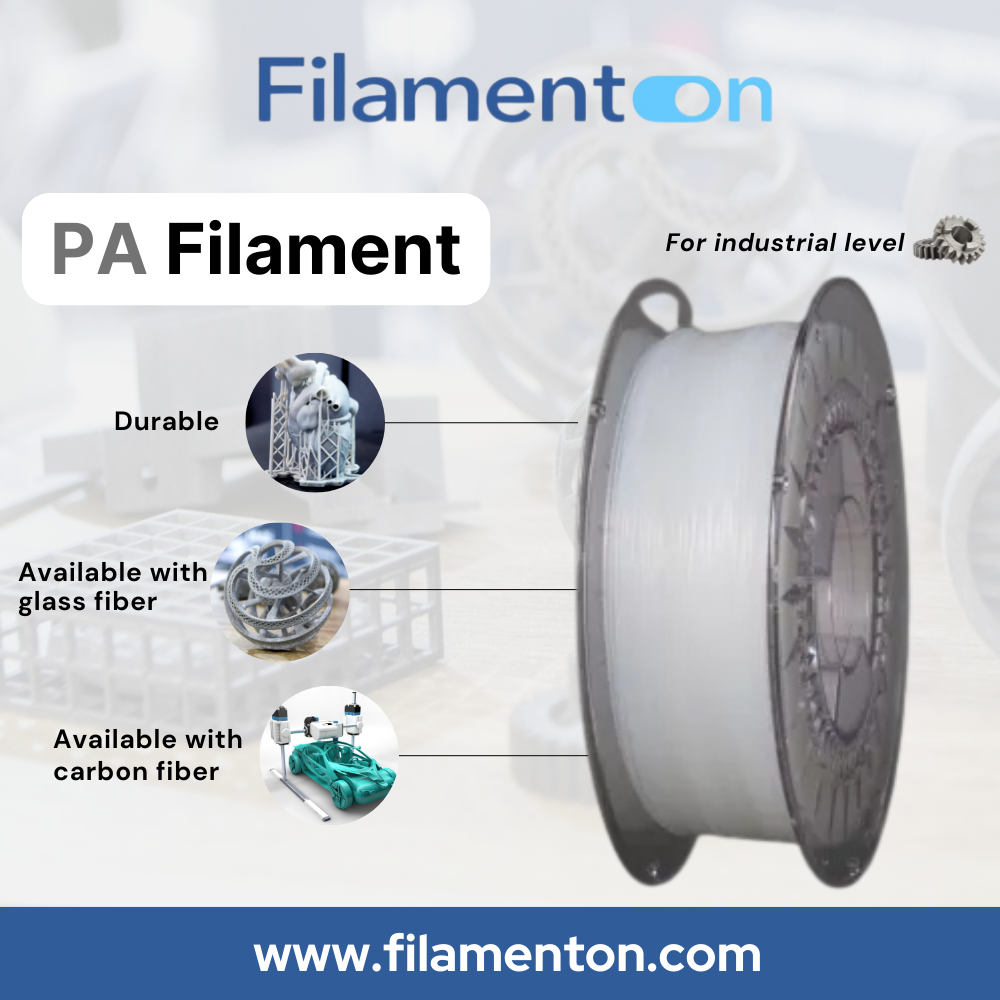
PA (Nylon) — the strong, flexible engineering mainstay of 3D printing
If PLA is the beginner’s buddy, PETG the dependable all-rounder, and ABS the classic industrial pick, then PA (polyamide—better known as nylon) is the true “pro” material. Few filaments can match its combination of strength, durability, and flexibility—which is why it’s a staple in industrial applications.
The science: what is PA?
Polyamides are a broad family of polymers whose chemical structure forms strong hydrogen bonds between chains. That internal bonding drives high tensile strength, excellent wear resistance, and resilience. Nylon isn’t just for 3D printing—think gears, tie-down straps, textile fibers, and even fishing line.
In 3D printing you’ll most often see PA6 and PA12 grades, along with glass-fiber (GF) and carbon-fiber (CF) reinforced blends that push performance even further.
A short history
Nylon was developed in the 1930s and first became famous in textiles (the nylon-stocking era says it all). It entered desktop 3D printing in the early 2010s, as manufacturers sought truly functional, engineering-grade materials. Today it’s one of the go-to choices for industrial and professional FDM/FFF printers.
How to print PA
Printing nylon is a challenge suited to advanced users—but the results are absolutely worth it.
- Nozzle temperature: 240–270 °C (some grades may need up to ~290 °C)
- Bed temperature: 70–100 °C
- Build environment: ideally an enclosed, heated chamber to reduce warping
- Part cooling: minimal to none
- Bed adhesion: specialty surfaces help a lot (e.g., garolite/G10, textured build plates)
Most important: PA is highly hygroscopic. If it absorbs moisture, you’ll hear popping and see steam bubbles, stringing, and rough surfaces. Always store it dry and dry the spool before printing (e.g., 70 °C for 4–6 hours).
Pros and cons
Pros
- Very strong and highly wear-resistant
- Tough and flexible—hard to crack or snap
- Excellent heat and chemical resistance
- Pairs well with reinforcements (glass fiber, carbon fiber)
Cons
- Tricky to print (warping, moisture uptake)
- Prefers specific printer conditions (enclosure, higher temperatures)
- Surface finish is more functional than cosmetic
Who is it for? What should you make with it?
Ideal for:
- Industrial and engineering parts under sustained mechanical load
- Gears, bearing housings, assembly aids and fixtures
- Tools and components requiring chemical and abrasion resistance
- Prototypes that must be tested under real-world conditions
Not ideal for:
- Simple decorative projects
- Open-frame desktop printers (risk of warping and layer splitting)
- Absolute beginners to 3D printing
Why FilamentOn PA TECH?
Our PA lineup sits under the TECH range, purpose-built for industrial and engineering use. It’s available in both 1.75 mm and 2.85 mm, with a dedicated CF option when stiffness is critical. In short: a cleanly tiered portfolio—from “straight” PA12 to serious reinforced blends—supported by a competitive, local supply. FilamentOn’s PA selection already covers most engineering needs with three strong technical options. If you’re exploring nylon, this is a great place to start:
What’s in the PA category?
- FilamentOn TECH PA12-H — tough, industrial-grade PA12; also available in 2.85 mm. Built for stable, functional parts when durability comes first.
- FilamentOn TECH PA12-W — PA12 offered in both 1.75 mm and 2.85 mm to fit your printer fleet. A solid pick for prototypes and long-lasting, wear-resistant add-ons.
- FilamentOn TECH PAHT-CF — carbon-fiber-reinforced, high-heat PA blend in 1.75 mm; choose this when you need stiffness, dimensional stability, and low creep (enclosures, machine parts, jigs/fixtures).
Summary
PA is true engineering-grade material: not the easiest to handle, but exceptionally versatile and durable. When PLA or PETG isn’t enough and you need a filament for real, industrial-style use, polyamide (nylon) is hard to beat.