
Polypropylene (PP) is one of the lightest and most flexible 3D printing materials, offering excellent chemical resistance. Although it can be challenging to print, under the right conditions it produces durable, flexible, and impact-resistant parts. It is ideal for industrial and specialized applications.
Knowledge Hub
What to Print With, and Why? – PP
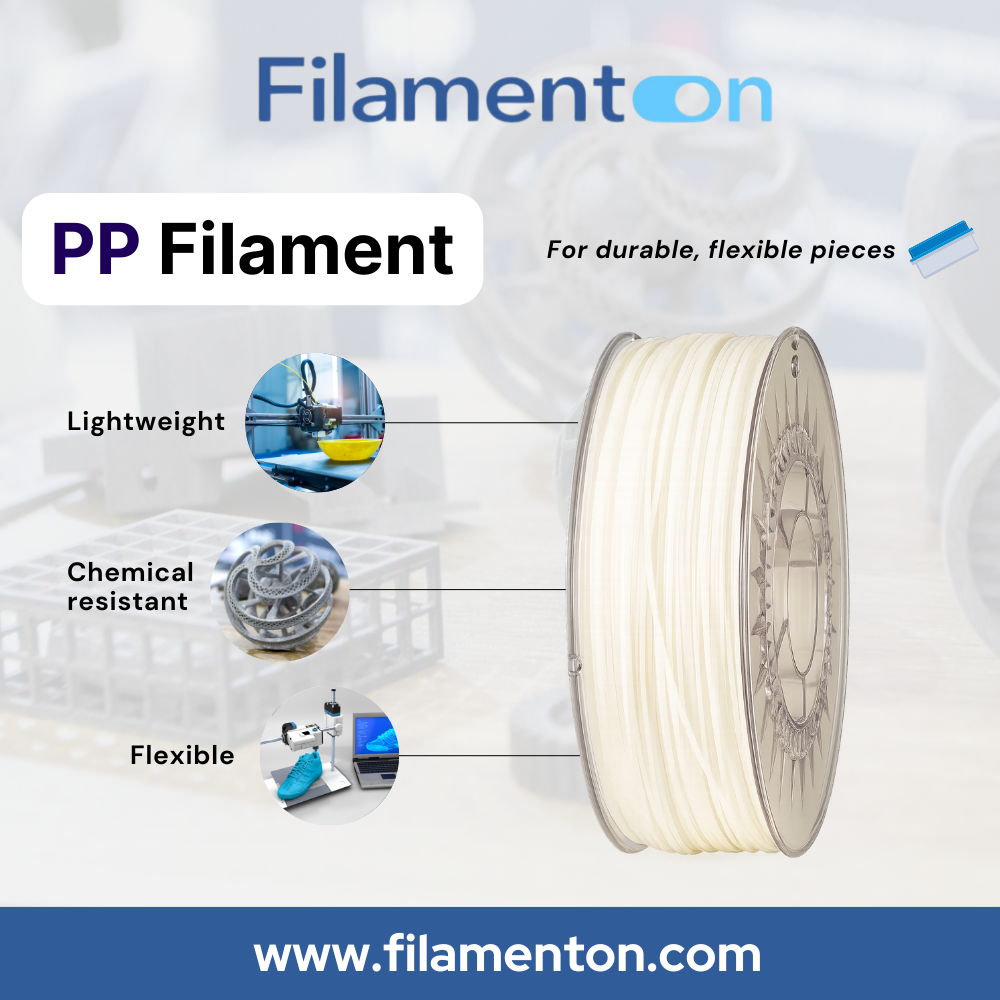
Polypropylene (PP) is one of the most widely used plastics in the world: it’s found in food containers, automotive parts, packaging materials, and even in the textile industry. It’s no surprise, then, that it has also made its way into 3D printing. PP offers properties that make it unique for many specialized applications.
What is PP?
Polypropylene is a polyolefin-type plastic that, thanks to its crystalline structure, is extremely lightweight, chemically resistant, and flexible. Its density is lower than that of most other filaments. Due to its elasticity, PP is a highly bendable material that is therefore not prone to breaking.
How to Print with PP Filament
Key settings:
- Nozzle temperature: 220–250 °C
- Bed temperature: 80–100 °C
- Print chamber: an enclosed, draft-free chamber is strongly recommended
- Adhesion: PP adheres very poorly to glass or PEI build plates – it often needs to be printed on a polypropylene surface (e.g., PP adhesive tape or PP sheet), since identical materials bond best to each other
- Drying: recommended
Advantages and Disadvantages
Advantages:
- Lightweight (low density)
- Flexible and bendable, difficult to break
- Excellent chemical resistance (resistant to acids, bases, and solvents)
- Good impact strength
Disadvantages:
- Difficult to print due to poor adhesion and warping
- Limited heat resistance (can soften below approx. 100 °C)
- Surface finish not always aesthetic; difficult to polish to a glossy shine
- Not ideal for all household projects
Who Should Use It and For What?
PP is an ideal choice if you need:
- Chemically resistant containers, bottles, tubes, or lab equipment
- Materials suitable for food contact (under appropriate conditions)
- Flexible, lightweight, impact-resistant components
- Durable parts for automotive or industrial use that are not exposed to high heat
Why Choose FilamentOn PP?
If you’re looking for chemically resistant, lightweight, and flexible parts (such as caps, containers, pipe fittings, hinges, joints, laboratory or automotive accessories), TECH PP is a great place to start. With the right printing parameters, it delivers stable, reliable results.
Summary
PP offers properties that few other filaments can match: it is lightweight, chemically resistant, flexible, and durable. It is particularly recommended for industrial and specialized applications.