
In 3D printing, bed temperature plays a great role. It’s the foundation of good adhesion and consistent print quality. The right balance between heat and surface ensures that the first layer bonds firmly without warping or detaching. In this article, we’ll explore why bed temperature matters, how it affects your prints on a molecular level, and what settings lead to flawless results.
Knowledge Hub
Basics of printing - Bed temperature
Why Is Bed Temperature Important in 3D Printing?
Our #PrintingBasics series continues, where we explore the key parameters of 3D printing step by step — whether you are a beginner or an advanced user, our goal is to provide clear yet technically grounded guidance. This time, the focus is on bed temperature, one of the most crucial factors determining the success of any print.
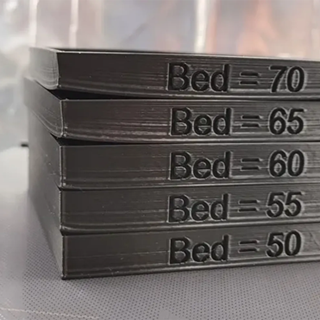
When we talk about the temperature of the print bed, we are really deciding how warm it should stay during the printing process, especially while the first layers are being deposited. At first glance, it may seem like a minor detail, but it is in fact the foundation of print quality. The proper bed temperature ensures sufficient adhesion, prevents deformation (the well-known warping phenomenon), and improves both the mechanical and aesthetic quality of the bottom layers. If the bed is too cold, the print will not adhere properly, corners may lift, the model may warp, or even detach entirely from the surface. Conversely, if the temperature is too high, the first layers may become overly soft, causing them to spread, stick too firmly, or even discolor depending on the material.
Behind this behavior are polymer physics processes. During 3D printing, layer adhesion is not just mechanical — it also occurs on a molecular level. The diffusion and chain rearrangement between adjacent polymer layers determine the final bond strength. The bed temperature directly influences the extent to which these processes occur. When the print bed temperature is raised above the polymer’s glass transition temperature (Tg) — but not excessively — adhesion forces between the first layer and the surface increase significantly. This happens because higher temperatures enhance polymer chain mobility, promoting molecular diffusion between material layers and the “neck growth” process [1]. In addition, proper temperature control reduces interlayer voids, which increases mechanical strength and improves surface finish. [2]
Different filament types naturally behave differently. PLA generally performs best with a bed temperature between 50–60 °C, while PLA+ often benefits from slightly higher temperatures, around 55–65 °C. PETG prints optimally between 70–85 °C, which promotes adhesion but requires caution, as excessive heat can cause deformation. ABS requires higher bed temperatures, typically between 90–110 °C, and is best used with an enclosed build chamber. TPU, on the other hand, adheres well even between 40–60 °C, since its flexible structure allows it to form good surface bonds at lower temperatures. [3]
It is important to note that temperature alone does not guarantee success — the bed surface is just as critical. For example, glass beds produce smooth, glossy bottom layers but only work well when leveled precisely. PEI sheets are excellent all-purpose surfaces, offering reliable adhesion for both PLA and PETG. Textured steel plates and BuildTak surfaces provide extra grip but can cause over-adhesion with PETG, making prints difficult to remove. Kapton tape and blue painter’s tape are inexpensive alternatives but wear out quickly and require frequent replacement. In some cases — especially with PETG and TPU — applying a thin layer of glue stick or hairspray as a release agent can prevent excessive sticking. [4]
The first layer of a print almost always determines the final result. If you hear crackling, clicking, or notice corner lifting, the bed is likely too cold. In such cases, try printing the first layer more slowly and with a slightly thicker layer height to help the material settle better. Adhesion aids such as brims or rafts can also help prevent edge lifting or warping.
It is also worth remembering that every filament reacts differently to heat. After each material change, you should relevel the print bed, as varying thermal expansion rates can alter the first layer’s height — even small deviations can impact adhesion and print success.
In summary, bed temperature is far from a minor setting — it is one of the core parameters of 3D printing. The right combination of temperature and bed surface ensures consistent adhesion, dimensional stability, and high-quality prints — forming the very foundation on which every successful print is built.
References
- Thumsorn, S., Prasong, W., Kurose, T., Ishigami, A., Kobayashi, Y., & Ito, H. (2022). Rheological behavior and dynamic mechanical properties for interpretation of layer adhesion in FDM 3D printing. Polymers, 14(13), 2721. https://doi.org/10.3390/polym14132721
- Pang, R., Zhang, Y., Chen, Y., & Liu, Z. (2025). Influence of temperature on interlayer adhesion and mechanical properties in material extrusion 3D printing. Journal of Manufacturing and Materials Processing, 9(6), 196. https://doi.org/10.3390/jmmp9060196
- Aliheidari, N., Tripuraneni, R., Hohimer, C., Christ, J., Ameli, A., & Nadimpalli, S. (2017, April). The impact of nozzle and bed temperatures on the fracture resistance of FDM printed materials. In Behavior and Mechanics of Multifunctional Materials and Composites 2017 (Vol. 10165, pp. 222-230). https://doi.org/10.1117/12.2260105
- Cozzolino, E., Napolitano, F., Papa, I., Squillace, A., & Astarita, A. (2025). Influence of the heated-bed material on PLA mechanical properties and energy consumption in the FDM process. Arabian Journal for Science and Engineering, 50(4), 2443-2453. https://doi.org/10.1007/s13369-024-09170-8