
One of the biggest challenges in producing complex 3D printed parts is choosing the right support material. PVA (polyvinyl alcohol) provides an effective solution, as it dissolves in water, allowing all support structures to be completely removed from the finished model. This makes it possible to achieve a clean and precise final result, even with the most intricate geometries.
Knowledge Hub
What to Print With, and Why? – PVA
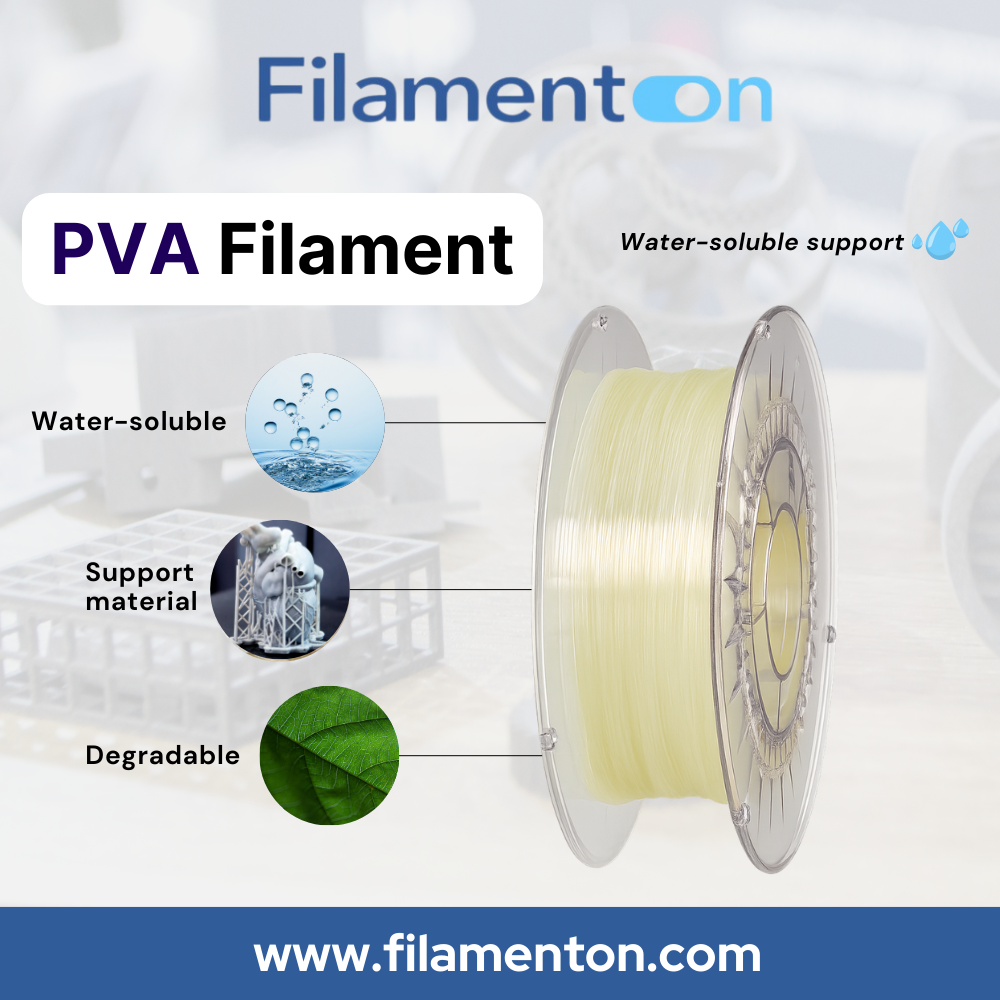
PVA – The Water-Soluble Support Material
If you have ever printed a complex geometry with many overhangs, you know how challenging it can be to remove support material cleanly. The solution to this problem is PVA (polyvinyl alcohol), a material that dissolves in water, making it an ideal support filament for projects where you want to remove supports without leaving any residue.
What is PVA?
Polyvinyl alcohol is a synthetic polymer whose molecules dissolve easily in water. This property makes it highly useful in 3D printing, where PVA is combined with other filaments, such as PLA or PETG, to serve as a water-soluble support material.
How to print with PVA filament
Key settings:
- Nozzle temperature: 180–210 °C
- Bed temperature: 45–60 °C
- Storage: PVA is extremely hygroscopic, meaning it quickly absorbs moisture from the air. Always store it in a dry, airtight container, as exposure to humidity can make it unprintable.
- Extruder: Works best with direct drive systems, since it is a soft and easily breakable filament.
- Drying: Before use, dry at 45 °C for at least 10 hours.
Advantages and disadvantages
Advantages:
- Completely dissolves in water, no chemicals required
- Perfect support material for complex geometries
- Compatible with PLA and other low-temperature materials
Disadvantages:
- Highly moisture-sensitive, requires careful storage and handling
- Rarely used on its own
- More expensive than most standard materials
- Not suitable for high-temperature filaments like ABS or nylon
Who should use PVA and when?
PVA is an excellent choice if you:
- Use a dual-extruder printer
- Print complex models with organic shapes, hollow structures, or moving parts
- Want clean, precise results without post-processing, sanding, or trimming
Why choose FilamentOn TECH PVA?
Because PVA is a sensitive material, consistent manufacturing quality and strict quality control are crucial.
FilamentOn TECH PVA ensures smooth, reliable printing and guarantees that your supports can be dissolved quickly and completely.
Summary
PVA is not an everyday filament, but a specialized tool for advanced 3D printing tasks.
If you work with complex geometries and want your support structures to disappear without a trace, PVA is one of the best choices you can make.