
Knowledge Hub
Layer by Layer: The History of Hobby 3D Printing – Part 11
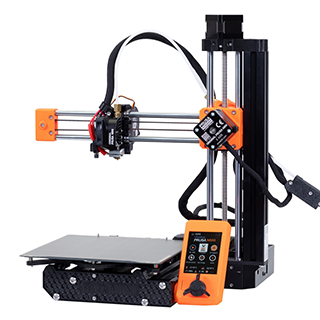
In the history of 3D printing’s evolution, few machines have had as much impact on the community as the Prusa Mini. This compact yet full-featured printer proved that a small footprint doesn’t require compromises in precision or reliability. In this article, we explore how the Mini and Mini+ became two of the most popular and well-loved models in modern desktop 3D printing.
Original Prusa Mini / Mini+ (2019 to 2020)
A printer that deserves to be taken seriously even in a small form factor
In our series we continue through the defining machines of the last twenty years of 3D printing. This time the focus is on the Prusa Mini, the printer that proved compact size does not mean a compromise in reliability or performance. The model created under the name of Josef Prusa debuted in 2019 and quickly became one of the most popular small format 3D printers in the world.
The Mini was originally designed as a more affordable and simpler alternative to the larger MK3 sibling, but it soon became clear that the concept was more than a secondary machine. This model grew into one of the most stable and well built members of the Prusa ecosystem. The Mini+ version introduced in 2020 further refined the design with more reliable sensors, a more advanced calibration system, and a stiffer extruder assembly.
Construction and mechanical system
The Prusa Mini uses a compact open frame that combines steel parts with 3D printed components. This approach delivers rigidity, precision, and easy assembly. The machine is not flashy, yet every detail reflects careful engineering. The Cartesian motion system follows proven Prusa principles. The bed moves along the Y axis, while the extruder travels on X and Z. Linear bearings and reinforced shafts provide accurate motion with minimal vibration.
The extruder is a Bowden setup with a custom hotend. Although it is not direct drive, it handles filament very well and is easy to maintain. Thanks to the low moving mass it enables fast and precise printing. The Mini was built for quiet, reliable, and responsive operation.
Electronics, software, and performance
One of the Prusa Mini’s greatest strengths is its modern custom 32 bit control board with TMC2209 stepper drivers for quiet operation and precise motion control. The software stack is open source and runs Prusa Firmware, which the manufacturer updates and optimizes regularly. The printer uses 1.75 mm filament and supports popular materials including PLA, PETG, ABS, ASA, and TPU.
The magnetic PEI coated spring steel build plate is a Prusa hallmark and makes part removal and cleanup straightforward. The 180 × 180 × 180 mm build volume is compact yet practical. The heated bed reaches up to 100 °C, which covers most materials. Typical print speeds are 40 to 80 mm per second, and the machine can reach up to 200 mm per second. Layer height is adjustable from 0.05 to 0.3 mm.
Features, innovations, and user experience
The Mini plays the role of a little sibling, yet it is not a stripped version. It provides the same print quality and reliability as the MK3 in a smaller package. The SuperPINDA sensor performs automatic first layer calibration before each print, which removes the errors of manual leveling. The machine offers a LAN port and a USB port, so it can be controlled over a network, and it is fully compatible with PrusaSlicer and Prusa Connect.
The swappable spring steel sheet supports efficient workflow, and the wider ecosystem ensures that the Mini slots smoothly into Prusa farms and multi printer setups. Quiet operation, reliability, and strong output have made it a first choice for many schools, small businesses, and hobby users.
Mini+ improvements
The Mini+ released in 2020 brought several small but important upgrades. The most significant change was the SuperPINDA sensor, which improved thermal stability and first layer accuracy. Factory assembly became more precise, the extruder assembly became stiffer, and the firmware received numerous optimizations. These changes further increased reliability, so the Mini+ remains one of the most popular compact FDM machines on the market.
Who is it for
The Prusa Mini is an ideal choice for anyone who wants a reliable, compact, and easy to use 3D printer. It is simple for complete beginners, and in educational environments it is safe and easy to maintain. For advanced users and small print farms it also serves well as a secondary machine thanks to networking features and automatic calibration.
Legacy and impact
The Prusa Mini proved that size is not a limiting factor in 3D printing. It is compact yet delivers professional level performance, and it set a new benchmark for machines that are both affordable and dependable. Through the Mini, Prusa once again combined engineering precision, an open source philosophy, and a user friendly experience in a device that literally fits on a desk.
In one sentence
The Prusa Mini is the Swiss Army knife of 3D printers, small, precise, smart, and consistently reliable, a true all rounder that shows how to achieve big results with a small footprint.