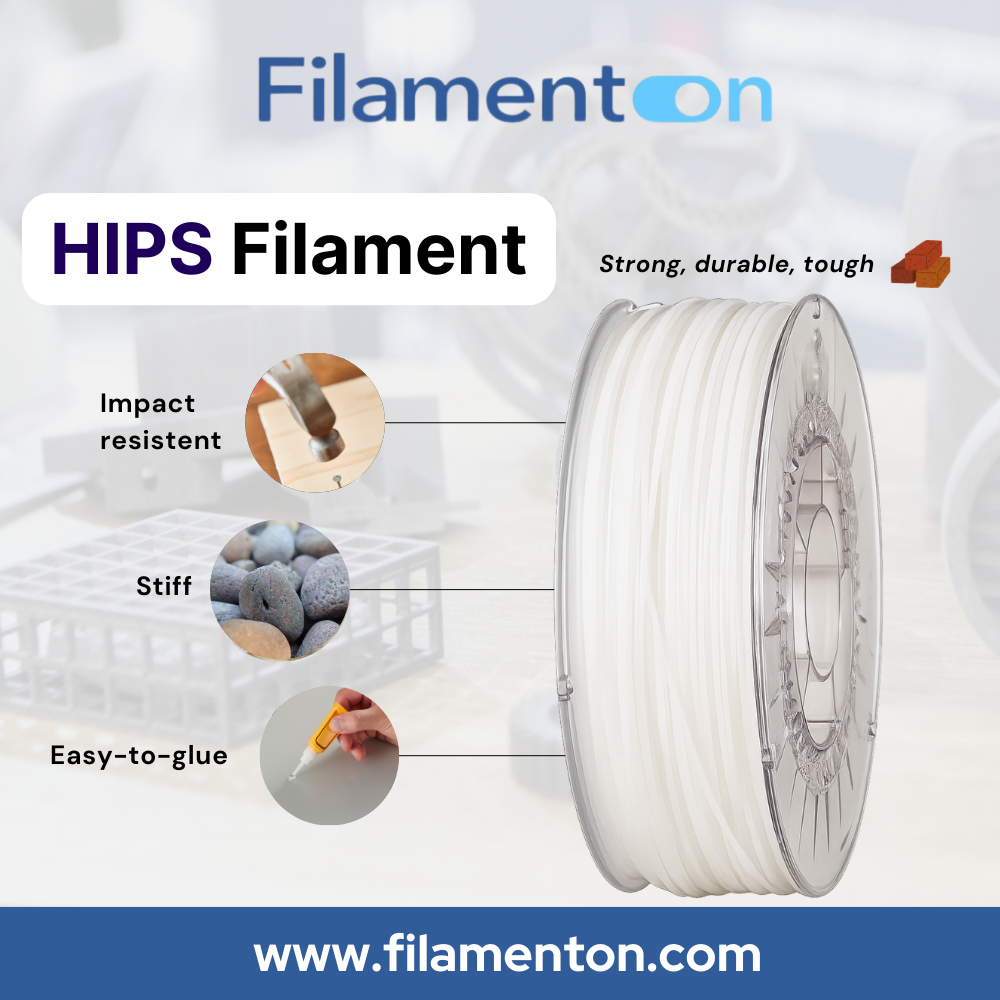
HIPS – Lightweight, Strong, and Dissolvable Support Material
In the world of 3D printing, HIPS (High Impact Polystyrene) is a truly “dual-purpose” material. On one hand, it is an excellent standalone filament—lightweight, rigid, and impact-resistant. On the other hand, it is widely known as a dissolvable support material, as it can be dissolved in certain solvents (such as D-limonene). This dual nature makes HIPS particularly unique and versatile.
Scientific Background – What Is HIPS?
HIPS is an উন্নanced version of polystyrene (PS), modified with butadiene to improve impact resistance and reduce brittleness. This combination results in a lightweight, rigid, yet durable material that has long been used in various industrial applications (e.g., enclosures, household products, packaging materials).
In 3D printing, one of the key advantages of HIPS is its solubility in D-limonene. For this reason, it is often used as a support material alongside ABS: in complex geometries, HIPS supports can be easily dissolved away, leaving a clean surface on the main material.
A Brief History
HIPS has been used in the plastics industry for decades and became popular in 3D printing alongside ABS. With the emergence of dual-extrusion printers, HIPS quickly gained traction as a dissolvable support material. It was one of the first truly practical solutions for achieving clean and precise prints of complex models.
How to Print with HIPS
Printing HIPS is similar to ABS, which is not surprising given their good adhesion to each other.
Nozzle temperature: 230–250 °C
Bed temperature: 90–110 °C
Print chamber: enclosed and heated recommended to avoid warping
Adhesion: works well on PEI, Kapton, or ABS juice-coated surfaces
Post-processing: dissolvable in D-limonene; can also be sanded and painted as a standalone material
HIPS is also prone to warping, so a stable, draft-free environment is recommended during printing.
Advantages and Disadvantages
Advantages
Lightweight and impact-resistant
Excellent adhesion to ABS → ideal support material
Dissolvable in D-limonene → clean removal
Easy to paint and sand
Disadvantages
Similar printing difficulty to ABS
Prone to warping
Requires solvent for support removal (unlike PVA, water alone is not sufficient)
Who Is It For and When to Use It?
HIPS is a versatile choice:
Support material for ABS prints—especially with dual-extruder printers
Standalone prints requiring lightweight, impact-resistant, and paintable parts (e.g., enclosures, prototypes, models)
Projects where dissolvability and clean surface finish are important
Not recommended:
For beginners without an enclosed printer
In cases where water-soluble supports are preferable (e.g., PLA → PVA)
Why FilamentOn TECH HIPS?
HIPS is a lightweight, impact-resistant, and easy-to-process material—ideal as a dissolvable support for ABS (dissolves in D-limonene), while also providing strong and cleanly paintable surfaces as a standalone material. At FilamentOn, it is available in a dedicated, engineering-focused TECH HIPS category.
What’s Currently Available?
FilamentOn TECH HIPS – 1.75 / 2.85 mm, Natural, 1 kg – in stock, 8,490 HUF
A universal choice for ABS projects as support material, as well as for lightweight enclosures and prototypes.
Summary
HIPS is one of those materials that performs well in multiple roles: as a standalone filament for strong and lightweight prints, and as an ideal dissolvable support material when paired with ABS. Although it is not the easiest to print, its versatility and unique solubility make it well worth exploring.