
Knowledge Hub
Printing Basics – Brim, Skirt, and Raft
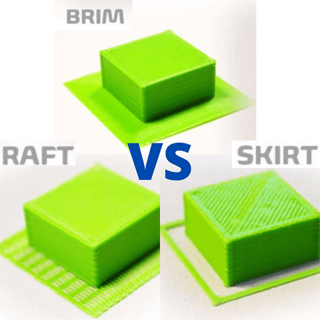
One of the most important—yet often underestimated—factors in successful 3D printing is first-layer adhesion. If this layer does not adhere properly, the print may warp, detach, or even fail. In this article, we present how the Skirt, Brim, and Raft settings help ensure that printing starts on a stable foundation from the very first moment.
Brim, Skirt, or Raft? – The Science of First-Layer Stability
Our #PrintingBasics series continues, examining the most important principles and technical settings of 3D printing in a professional yet accessible way. In today’s part, we analyze three methods that improve first-layer adhesion: Skirt, Brim, and Raft. Although these settings may seem minor, they actually play a decisive role in determining whether a print will succeed or fail.
The first layer is not only the foundation of the print but also the key to its overall mechanical stability: if it detaches or shifts, the entire model becomes defective.
The Role of the First Layer in Adhesion
During 3D printing, the first layer ensures adhesion between the print bed and the polymer. The quality of this process is determined by temperature, surface energy, and the polymer's rheological behavior. If adhesion is insufficient, the print may deform, detach, or partially shift.
Skirt, Brim, and Raft techniques are all designed to ensure a stable start, promote consistent extrusion, and establish strong interlayer bonding from the very beginning. [1]
Skirt – A Reliable Start
The Skirt is one of the simplest yet most essential adhesion aids. The printer draws one or more closed loops around the model without touching it. This process primes the extrusion, removes trapped air or solidified material from the nozzle, and ensures that the extruder pressure stabilizes before the actual print begins (Turner & Gold, 2015).
This method reduces the risk of improper material deposition in the first layer, which is especially important for precision prints or projects using fine layer heights. The Skirt can be seen as a “warm-up” phase of the process and is recommended for virtually every print—it is the minimum safeguard for a successful start. [1]
Brim – Increasing Adhesion
The Brim is a flange attached to the first layer of the model that extends outward to increase contact between the object and the build plate. This method is particularly effective in preventing warping, i.e., curling caused by thermal shrinkage.
The Brim distributes thermal stress, provides more uniform cooling, and effectively stabilizes corners. It is an ideal solution for large-surface or narrow-base models, especially when printing with PLA, PETG, or ABS, where the polymer shrinkage coefficient is higher.
The physical basis of adhesion here lies in the increased contact area and improved heat conduction in the first layer, making the Brim one of the simplest yet highly effective methods for ensuring stability. [2]
Raft – Redefining the Foundation
The Raft is the most effective but also the most material-intensive solution. In this case, the printer creates a thick, mesh-like base consisting of multiple layers, on top of which the model is built.
This layer separates the model from minor imperfections of the print bed, smooths out unevenness, and ensures optimal heat distribution. The Raft is particularly useful for low-cost or unevenly heated beds, or when the model base is not flat, such as for 3D-scanned geometries that may be distorted.
Its disadvantage is that it significantly increases print time and material usage, and removal can be difficult, especially with PETG or composite filaments. Therefore, the Raft is typically used as a “last resort,” when the Brim is no longer sufficient to ensure adhesion. [3]
Materials Science Background
The functioning of Brim, Skirt, and Raft is rooted in the adhesive and cohesive behavior of polymers. Adhesion between layers and between the print bed and the material can be explained by molecular diffusion and intermolecular forces.
Higher temperatures increase polymer chain mobility, enhancing bonding in the first layer. In contrast, uneven heat distribution or rapid cooling often leads to deformation and layer separation in prints without a Brim.
Therefore, any setting that improves temperature stability and surface contact directly increases the probability of a successful print. [4]
Summary
Skirt, Brim, and Raft are not merely auxiliary features but fundamental stabilizing elements of 3D printing. The Skirt ensures a reliable start, the Brim enhances mechanical adhesion, and the Raft creates an entirely new foundation when other methods are insufficient.
Together, these techniques make the most critical phase of printing—the formation of the first layer—more reliable. As polymer research has shown, proper adhesion is the key prerequisite for layer stability and aesthetic quality—and it all depends on the very first millimeter.
References
- Ahmed, B. A., Saleh, H. M., Jameel, M. M., & Al-Taie, A. (2024). Evaluation of Skirt-Raft Foundation Performance Adjacent to Unsupported Excavations. Civil Engineering Journal, 10(12). DOI: 10.28991/CEJ-2024-010-12-018
- Bao, W. (2023). Resolving warping in 3D printing of thermoplastic parts via heterostructure brim. Materials Letters, 351, 135032. https://doi.org/10.1016/j.matlet.2023.135032
- Bhandarkar, V. V., Bose, S., Gupta, A. K., & Tandon, P. (2024). Enhancing printability and sustainability in three-dimensional printing of challenging polymers by integrating an easy-to-print polymer raft. Proceedings of the Institution of Mechanical Engineers, Part E: Journal of Process Mechanical Engineering, 09544089241305238. https://doi.org/10.1177/09544089241305238
- Wang, T. M., Xi, J. T., & Jin, Y. (2007). A model research for prototype warp deformation in the FDM process. The International Journal of Advanced Manufacturing Technology, 33(11), 1087–1096. https://doi.org/10.1007/s00170-006-0556-9