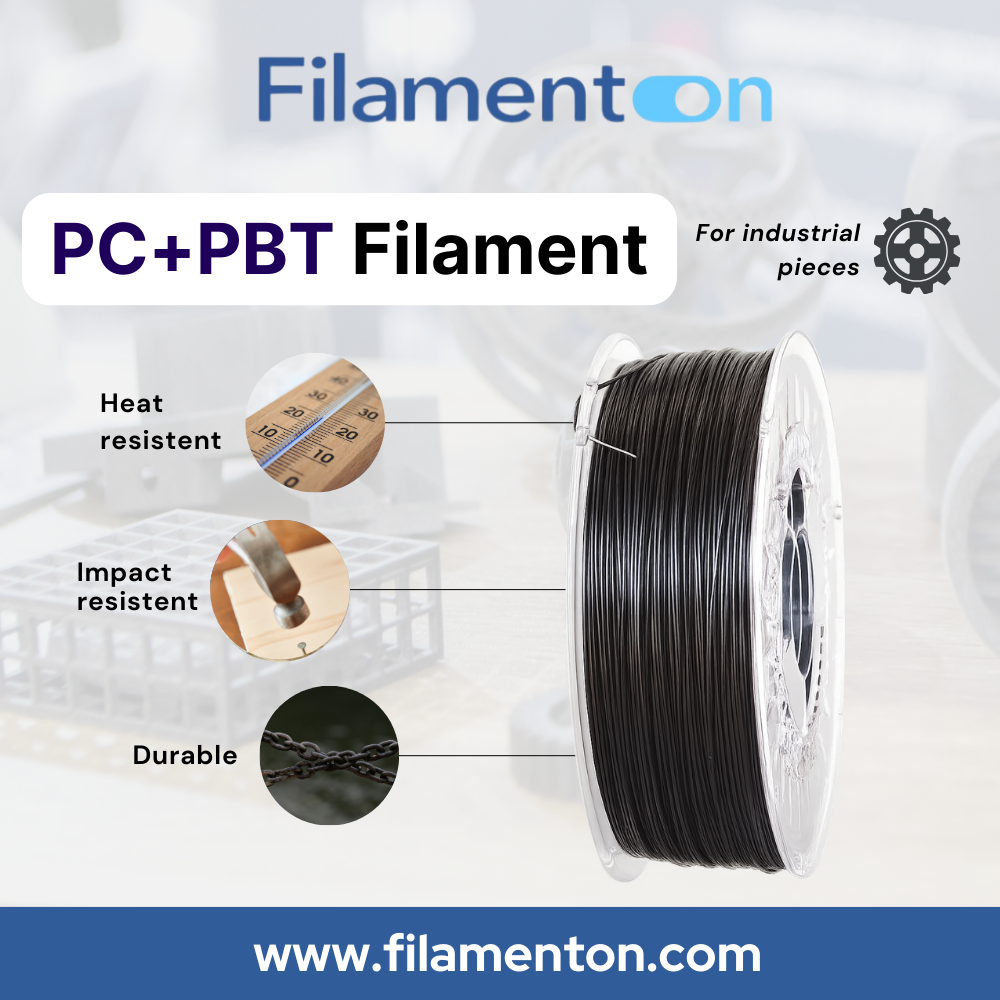
PC+PBT – Where Flexibility Meets Durability
In the world of 3D printing, many composite materials aim to combine the advantages of multiple polymers while minimizing their drawbacks. PC+PBT (polycarbonate + polybutylene terephthalate) is exactly such a “hybrid” filament: it merges the high strength and heat resistance of PC with the flexibility and chemical resistance of PBT. The result is a highly reliable, industrial-grade printing material.
Scientific Background – What Is PC+PBT?
Polycarbonate (PC) has long been known in the plastics industry, especially for applications requiring transparency, impact resistance, and heat resistance (e.g., protective shields and lenses). However, its drawbacks include brittleness and difficult processability.
Polybutylene terephthalate (PBT), on the other hand, is a semi-crystalline polyester that offers excellent chemical resistance, electrical insulation, and dimensional stability.
By combining these two materials (PC+PBT blend), a filament is created that is strong, heat- and chemical-resistant, yet less brittle and easier to process.
How to Print with PC+PBT
Nozzle temperature: 250–280 °C
Bed temperature: 90–110 °C
Print chamber: enclosed and heated, strongly recommended (due to warping)
Adhesion: PEI, specialized adhesives, or coated build plates are recommended
Post-processing: heat treatment (annealing) can further improve dimensional stability and crystallinity
PC+PBT is more stable to print than pure PC, but its temperature requirements remain high, making it better suited to users with advanced hardware.
Advantages and Disadvantages
Advantages
High heat resistance (up to 120–140 °C)
Excellent chemical resistance (oils, greases, fuels)
Better impact resistance and flexibility compared to pure PC
Electrical insulating properties
Disadvantages
Requires high printing temperatures
Prone to warping
Less widely available, typically in the premium price range
Who Is It For and When to Use It?
PC+PBT is primarily suited for industrial applications:
Automotive components requiring both heat and chemical resistance
Electrical enclosures, due to their excellent insulating properties
Prototypes exposed to extreme mechanical or thermal stress
Parts used in chemical environments
Not recommended:
For beginners or users with open, hobby-level printers
For low-heat, decorative indoor applications
Why FilamentOn TECH PC+PBT?
PC+PBT combines the impact and scratch resistance of PC with the chemical resistance, low moisture absorption, and dimensional stability of PBT—specifically engineered for demanding technical applications. It is available in a dedicated TECH PC+PBT category.
What’s Currently Available?
FilamentOn TECH PC+PBT – Black – 1.75 / 2.85 mm (1 kg)
The product page highlights key features such as high impact and scratch resistance, excellent chemical resistance, and low moisture absorption. It is paintable and coatable, dimensionally accurate, and shrinkage-resistant.
Recommended settings for standard printers: 235–250 °C nozzle, 90–120 °C bed, minimal cooling
For high-speed/industrial machines: 270–290 °C nozzle, 100–110 °C bed, 50–60 °C chamber
Summary
PC+PBT is one of the most advanced engineering filaments, offering high heat and chemical resistance, excellent impact strength, and electrical insulation. Although it is not the easiest material to print, it is highly recommended for industrial and engineering applications.