
Knowledge Hub
What to Print With, and Why? – PMMA
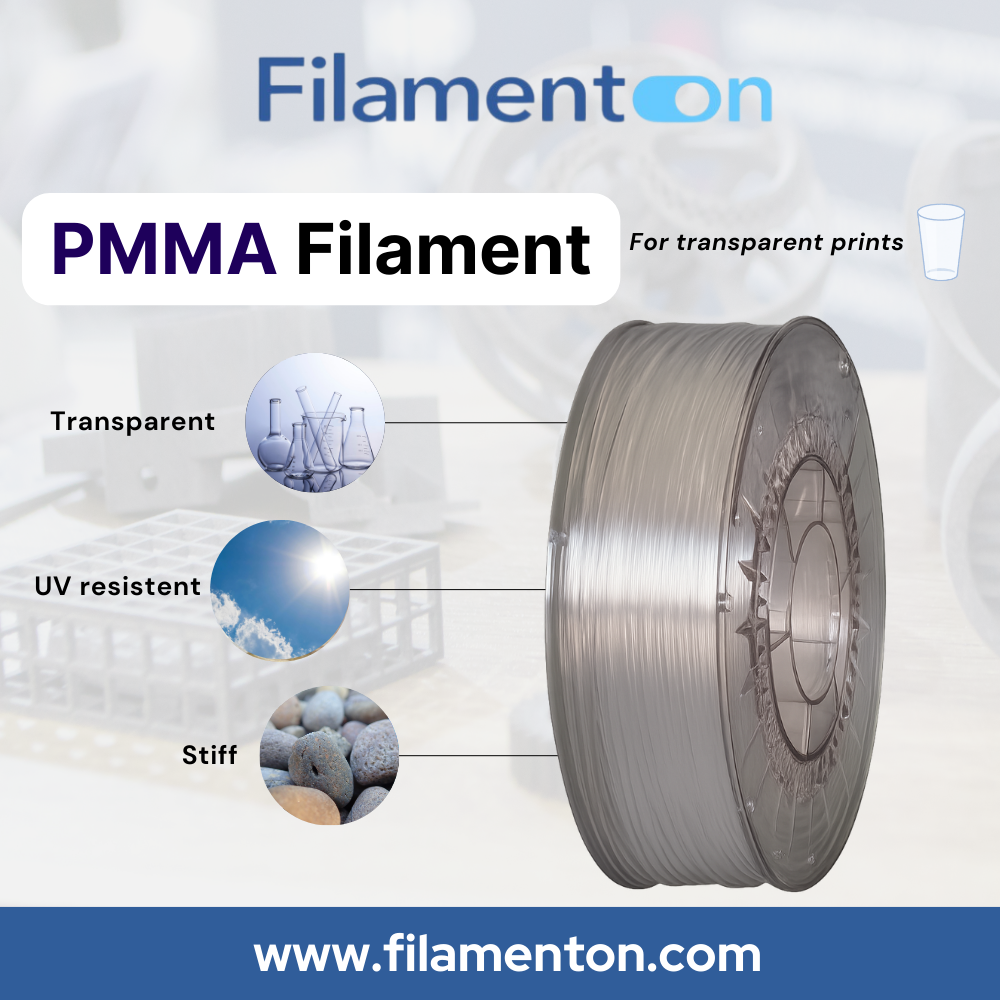
PMMA – The Transparent Filament Where Light and Aesthetics Matter
In 3D printing, there are only a few materials that are both practical and visually appealing—and PMMA (polymethyl methacrylate), commonly known as plexiglass or acrylic, is one of them. This material is uniquely transparent, lightweight, and durable, making it ideal for applications where appearance and light transmission are just as important as mechanical properties.
Scientific Background – What Is PMMA?
PMMA is a synthetic, amorphous polymer first developed in the 1920s, with “plexiglass” being its most widely recognized trade name. It was originally introduced as an alternative to traditional glass: lighter, more flexible, and less prone to breaking.
In 3D printing, PMMA is extruded from granules into filament form, allowing printed parts to retain many of its characteristic properties. With proper settings and post-processing, it is possible to achieve translucent, light-transmitting, and optically clear surfaces.
A Brief History
PMMA has long been used in industry, but it only began to appear in 3D printing much later, around the mid-2010s. Initially, it was offered only by specialized filament manufacturers, but today it is more widely available—primarily for projects where visual appearance plays a key role.
How to Print with PMMA
Nozzle temperature: 230–250 °C
Bed temperature: 80–100 °C
Enclosed print chamber: strongly recommended (due to warping)
Adhesion: glass or PEI sheet, with adhesive if necessary
Post-processing: sanding and polishing can enhance transparency
Printing PMMA presents challenges similar to ABS: it is prone to warping, so it performs best in a controlled, enclosed environment.
Advantages and Disadvantages
Advantages
Transparent, light-transmitting – glass-like appearance
Lightweight and more impact-resistant than glass
Good UV resistance (less yellowing compared to many other filaments)
Aesthetic surface, suitable for polishing
Disadvantages
Prone to warping
Not as impact-resistant as PC (polycarbonate)
More suitable for advanced users; it can be difficult for beginners
Who Is It For and When to Use It?
PMMA is an ideal choice if:
You want to create transparent objects (e.g., lamp covers, plexiglass-like lids, display housings)
You are working on aesthetic projects where visual appearance is critical
You need UV-resistant outdoor parts that can withstand sunlight
Not recommended:
For beginner users
For parts exposed to very high temperatures
If extreme impact resistance is required (PC or Nylon is a better choice in such cases)
Why FilamentOn TECH PMMA?
Transparent, light-transmitting surface—ideal for design and lighting applications
Consistent pricing and stock availability—available in 1.75 and 2.85 mm, 9,990 HUF / 1 kg, in stock
TECH product line—structured specifically for engineering use, with a clear category system
What Can You Find in the PMMA Category?
FilamentOn TECH PMMA – Natural – 1.75 / 2.85 mm, 1 kg – In stock, 9,990 HUF
Designed for translucent, aesthetic prints (e.g., lamp covers, display lids, plexiglass-like enclosures)
Summary
PMMA is the “plexiglass” of 3D printing: it offers unique aesthetic possibilities while being durable, UV-resistant, and lighter than glass. Although it can be challenging to print, the results are exceptional—translucent, visually appealing, and functional parts.